

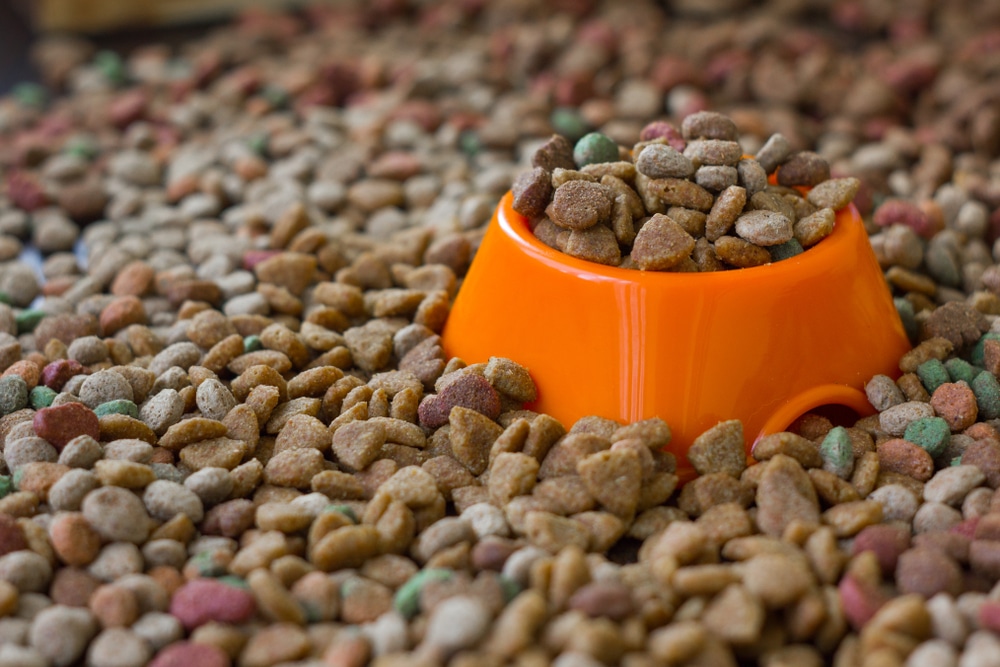
Modern pet food formulas use complex combinations of proteins, grains, powders, and additives to deliver both nutrition and flavor. However, many pet food bulk materials are notoriously difficult to handle. Some ingredients clump. Others stick to vessel walls. Many settle or separate during storage and transport.
Learn more about the most common materials used to make pet food, and how you can overcome material flow problems.
What are some of the most challenging pet food bulk materials?
- Meat and bone meal: protein-rich but sticky and prone to clumping
- Fish meal: oily and fine, making it easy to compact
- Soybean meal: dusty and hygroscopic, which absorbs moisture and packs down
- Whey powder: cohesive and sticky when exposed to air or moisture
- Rice bran: lightweight and flaky, often settles unevenly
- Powdered fats: smear and cling to vessel surfaces
- Vitamins and minerals: ultra-fine particles that resist flow
- Premixes and additives: highly cohesive and prone to segregation
What material flow problems can occur during pet food production?
A material’s natural properties—such as moisture content, particle size, shape, and cohesiveness—play a major role in how it flows through equipment. In pet food manufacturing, many bulk materials are sensitive to humidity, prone to compaction, or vary widely in density. These characteristics often lead to flow problems that disrupt production and affect product consistency.The most frequent issues include:
- Clumping: Material sticks together and forms lumps, especially under pressure or humidity
- Bridging: Material forms an arch over the outlet and blocks discharge
- Ratholing: Only a narrow channel of material flows, leaving the rest stagnant
- Wall buildup: Powders or moist ingredients cling to the sides of bins and hoppers
- Segregation: Particles separate by size, weight, or shape, leading to inconsistent mix quality
How can poor flow hurt your business?
Flow problems are more than just an inconvenience—they have a direct impact on your bottom line.
- Increased downtime: Operators may need to stop production to clear blockages manually, delaying batch cycles and shipment schedules.
- Higher labor costs: Manual cleanouts and extra inspections take time and staff, especially in compliance-heavy environments.
- Product loss and waste: When materials don’t flow properly, some may spoil in the vessel or become cross-contaminated during changeovers.
- Quality control risks: Uneven discharge or poor mixing can result in off-spec products, leading to rework or recalls.
- Equipment wear and damage: Using brute-force solutions like vibrators or manual poking can damage bins and silos over time.
In short, poor material flow leads to lower output, higher costs, and greater risk of quality and safety issues—all of which are especially critical in pet food manufacturing where consistency and cleanliness are non-negotiable.
How can pet food manufacturers solve material flow problems?
Not all flow aids can handle pet food bulk materials—especially those that are that are damp, oily, sticky, or prone to clumping and segregation.
However, AirSweep is proven effective for pet food production. Engineers customize each system based on the material and vessel—selecting the right AirSweep model, ideal mounting positions, air pressure, and firing sequence. This setup ensures first-in, first-out flow, even for the most challenging bulk powders and solids.
AirSweep also flushes material off the vessel walls, which minimizes the risk of stagnant or spoiled material. Some systems double as clean-in-place solutions. This is ideal for vessels that are used to make different types of formulas—they can be cleaned and sanitized between batch runs in half the time. Check this page to see how AirSweep is used in the pet industry.
Keep pet food bulk materials moving with AirSweep
Whether you’re moving oily fish meal, sticky whey powder, or flaky rice bran, AirSweep provides the reliable, food-safe solution that today’s pet food processors need. Ready to eliminate flow problems in your facility? Contact us today to learn how AirSweep can be tailored to your process.


Comments are closed